
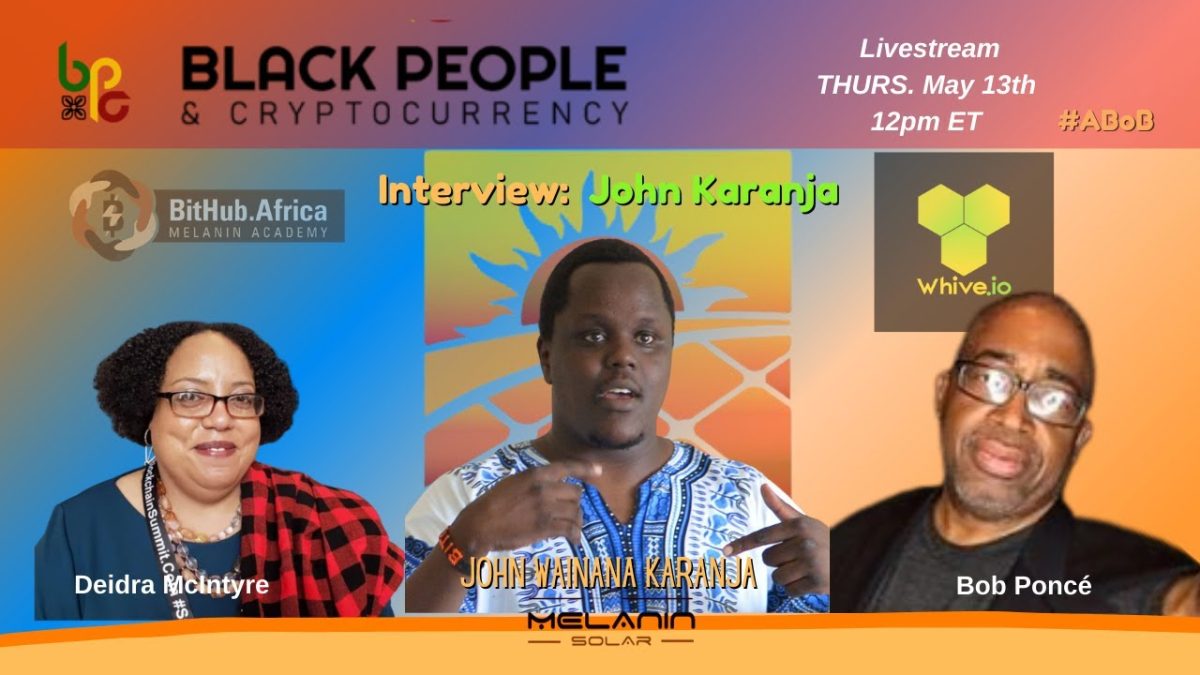
When Elon Musk announced Tesla would stop accepting Bitcoin due to environmental concerns, it sparked global debate about cryptocurrency’s energy consumption. John Wainaina Karanja, engineering lead of Africa’s first decentralized proof-of-work blockchain Whive Protocol and co-founder of BitHub Africa, has a different perspective on Bitcoin mining’s environmental impact.
In this exclusive interview from the “Black People & Cryptocurrency” series, Karanja addresses Musk’s claims while revealing how Bitcoin mining could actually accelerate Africa’s renewable energy adoption.
Debunking the Bitcoin Energy Myth
Karanja calls Musk’s position “quite misguided,” emphasizing the need for proper context when discussing Bitcoin’s energy consumption. “You cannot compare the cost-benefit analysis of Bitcoin being a digital monetary network and the traditional legacy system which is built on brick and mortar,” he explains.
The numbers tell a compelling story. Bitcoin mining consumes roughly the same amount of electricity as Denmark – significantly less than the global banking system’s energy requirements across major cities worldwide.
“If you look at all the big cities on earth, talk about New York which has a lot of banking institutions, they build huge towers with many floors just to offer banking services. These are replicated in every major city on earth,” Karanja notes. “How much energy is being used to support that ecosystem versus a digital ecosystem that is even much more efficient and liberating for people across the world?”
Bitcoin Already Runs on 75% Renewable Energy
Contrary to popular belief, Bitcoin mining already utilizes 75% renewable energy sources. This shift toward green energy isn’t accidental – it’s economically driven.
“The reason the majority of the energy Bitcoin uses is renewable is because it’s more sustainable to use renewable energy versus burning coal,” Karanja explains. Chinese Bitcoin miners actively seek underutilized hydroelectric dams – infrastructure that couldn’t previously transmit power to cities due to distance or lack of demand.
Bitcoin mining has essentially subsidized these renewable energy projects, creating local economies where value generation makes previously unviable green energy infrastructure profitable.
Africa’s Renewable Energy Opportunity
Karanja sees enormous potential for Africa to lead the renewable Bitcoin mining revolution. The continent possesses vast untapped renewable energy resources, particularly the Grand Inga Dam project in Democratic Republic of Congo.
“The Grand Inga Dam has a potential of 45,000 megawatts, which is enough electricity to serve the whole of sub-Saharan Africa,” he reveals. “But that project has not been able to be developed because the government of Congo doesn’t have enough resources.”
His solution? Follow China’s example by using that power to mine Bitcoin, making the dam economically viable. This approach could generate revenue to fund further development and eventually distribute power across Africa.
From E-commerce Failure to Blockchain Innovation
Karanja’s journey into Bitcoin began in December 2013 after his Kenyan e-commerce startup CloudPresser failed. The platform attempted to integrate with M-Pesa, Kenya’s pioneering mobile money system, but ran out of funding.
“If we knew about Bitcoin, we could probably have plugged it into our system and we wouldn’t have had to shut down our platform,” he reflects. This realization led him to study Bitcoin’s whitepaper intensively for a month.
The technical concepts fascinated Karanja, who had a computer science background. By 2014, he was speaking at Bitcoin conferences in Amsterdam, where he met other African Bitcoin pioneers including Sinclair Skinner and Alakanani Itireleng.
Building Africa’s Bitcoin Ecosystem
“We were the only three black people in a conference of three thousand,” Karanja recalls about the Amsterdam conference. This experience motivated him and co-founder Chris Cozber to establish BitHub Africa and organize Bitcoin meetups across seven African countries.
BitHub Africa became Africa’s first Bitcoin and blockchain accelerator, providing education and business resources for Africans entering the cryptocurrency space. The organization has since become a cornerstone of Africa’s blockchain ecosystem.
Connecting Energy Access with Financial Access
While working on Sinclair Skinner’s remittance startup in Zimbabwe, Karanja discovered a crucial connection between financial and energy access. Grant recipients were primarily using funds to purchase solar water pumps.
“I realized that there was a connection between financial access and solar access,” he explains. “People need money fundamentally in Africa to access energy because we’re still using biogas, we’re still using kerosene lamps.”
This insight led to the creation of Melanin Solar, focusing on renewable energy solutions for tropical regions, and influenced the development of Whive Protocol.
Key Takeaways
- Bitcoin mining uses the same energy as Denmark – less than traditional banking systems
- 75% of Bitcoin mining already runs on renewable energy sources
- Bitcoin incentivizes development of underutilized renewable energy infrastructure
- Africa’s Grand Inga Dam could power all of sub-Saharan Africa through Bitcoin mining revenue
- Financial access and energy access are interconnected challenges in Africa
- BitHub Africa pioneered blockchain education across seven African countries
- Whive Protocol represents Africa’s first indigenous proof-of-work blockchain
The Future of African Blockchain Innovation
Karanja’s work demonstrates how Bitcoin and blockchain technology can address Africa’s fundamental challenges while building sustainable energy infrastructure. Rather than viewing cryptocurrency as environmentally harmful, his approach shows how proof-of-work mining can accelerate renewable energy adoption.
Through BitHub Africa’s educational initiatives, Whive Protocol’s technical innovation, and Melanin Solar’s practical applications, Karanja continues building the foundation for Africa’s blockchain-powered renewable energy future.
Ready to explore Bitcoin and blockchain opportunities in Africa? Join BitHub Africa’s community and connect with pioneers shaping the continent’s cryptocurrency ecosystem.