
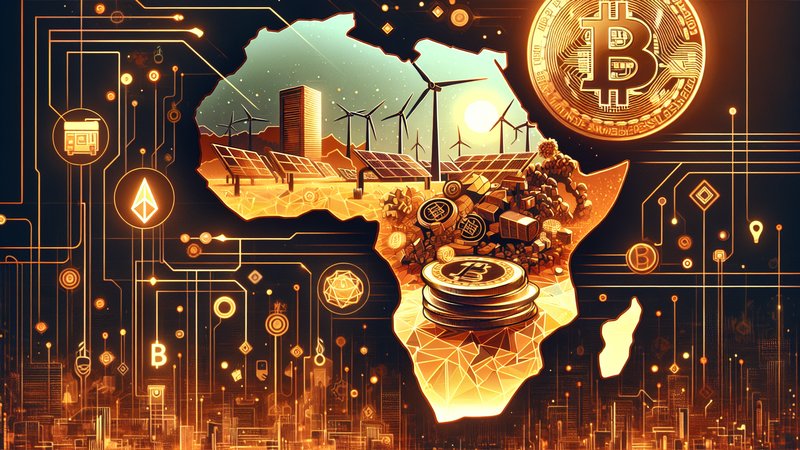
While critics debate Bitcoin’s environmental impact, innovative companies are proving that Bitcoin mining can actually solve Africa’s energy crisis. John Wainaina Karanja, CEO of Melanin Solar, presented groundbreaking solutions at the Black Blockchain Summit that could transform energy access for millions across the continent.
Africa’s Energy Access Challenge
The statistics are staggering: over 50% of Africa’s population lacks access to reliable energy. This energy poverty creates a vicious cycle where communities remain trapped in underdevelopment, unable to power businesses, schools, or healthcare facilities.
Traditional solar solutions face significant barriers. High capital expenditure requirements force consumers into expensive debt-based financing models. Rural populations with seasonal incomes struggle to make regular loan payments, hindering widespread adoption of renewable energy systems.
“Many people in rural Africa have seasonal incomes, so they’re not able to make regular payments towards their loans as people would often do in the west,” explains Karanja. “These debt-based models hinder adoption by farmers and consumers.”
Bitcoin Mining’s Renewable Energy Revolution
Contrary to popular belief, Bitcoin mining has become increasingly green. Today, approximately 56% of Bitcoin mining operations use renewable energy sources. This shift occurred as miners discovered the economic advantages of utilizing stranded energy resources.
Hydroelectric dams, wind farms, and solar installations often generate excess power that’s expensive to transmit over long distances. Bitcoin mining provides an immediate buyer for this “stranded” energy, making renewable projects financially viable.
“Bitcoin mining has come to fill in that gap where these idle stations have adopted Bitcoin mining as a way to pay for the costs of running the dam and pay for the investment,” notes Karanja.
The Dual Mining Innovation
Melanin Solar has developed an innovative approach called dual mining, combining traditional Bitcoin mining with the Whive Protocol. This system uses CPU-powered mining algorithms alongside ASIC miners to create additional revenue streams.
Think of CPU mining rewards as “air miles” – bonus points that make the entire system more economically attractive. This approach makes distributed solar systems financially viable for smaller installations across Africa.
Decentralizing Bitcoin Mining with Stratum V2
Current Bitcoin mining faces centralization risks, with just two mining pools controlling over 51% of the network’s hash rate. This concentration creates potential security vulnerabilities and reduces the network’s resilience.
Stratum V2 technology addresses these concerns by:
- Enhancing miner autonomy and decentralization
- Reducing communication overhead
- Improving efficiency and security
- Supporting off-grid solar mining operations
“Decentralizing the hash rate to protect the Bitcoin network is very important,” emphasizes Karanja. “We’re empowering small miners to avoid concentrated control.”
Technological Advances Enable Distributed Mining
Recent innovations are making small-scale Bitcoin mining more practical:
Liquid Cooling Systems: New cooling technologies reduce heat and noise pollution, making mining operations suitable for residential and community settings.
Energy Optimization: Smart mining systems can balance grid demand by increasing or decreasing operations based on energy availability. Excess daytime solar power can fuel mining operations, while heat generated can warm homes or support agricultural applications.
Mobile Computing Integration: ARM CPU-focused mining architectures are perfect for embedding in solar systems, leveraging the energy efficiency of mobile devices.
Real-World Applications Across Africa
Major infrastructure projects across Africa are already exploring Bitcoin mining integration:
The Grand Inga Dam in Congo and Ethiopia’s Grand Ethiopian Renaissance Dam represent massive renewable energy investments. Bitcoin mining can help subsidize these installations, making them economically sustainable while providing clean energy to millions.
Grid balancing becomes crucial as these projects come online. Bitcoin mining can absorb excess energy production, stabilizing the grid and maximizing renewable energy utilization.
Creating New Financial Instruments
Blockchain technology enables innovative financing mechanisms:
- Tokenization of energy assets
- Hash rate as a tradeable commodity
- Derivative markets for transaction fees
- Automated market makers for price stability
These tools can help communities finance energy infrastructure without relying on traditional debt-based models that have proven unsuitable for rural populations.
Open Source Development for Global Impact
Melanin Solar commits to transparency by publishing all code online for public auditing. This open-source approach accelerates innovation while addressing centralization risks posed by proprietary mining solutions.
“These technologies are very important and they have to be developed in an open and transparent manner,” states Karanja. “This allows for the creation of multiple solutions which will create decentralized peer-to-peer mining ecosystems.”
The goal is ambitious: connecting over 500,000 households already using solar power into decentralized energy markets across Africa and beyond.
Key Takeaways
- Bitcoin mining already uses 56% renewable energy and incentivizes further clean energy development
- Dual mining with CPU algorithms can make distributed solar systems economically viable
- Stratum V2 technology will decentralize mining and support off-grid operations
- Advanced cooling and optimization technologies enable community-scale mining
- Major African dam projects can use Bitcoin mining to subsidize renewable energy infrastructure
- Open-source development ensures transparent and accessible solutions
- Blockchain enables innovative financing mechanisms that avoid traditional debt models
The Path Forward
The convergence of Bitcoin mining and renewable energy presents unprecedented opportunities for addressing Africa’s energy crisis. By aligning economic incentives with environmental goals, this approach could leapfrog traditional energy infrastructure challenges.
Success requires continued technological innovation, regulatory support, and community education. The open-source nature of these solutions ensures that benefits can scale globally, potentially transforming energy access in developing regions worldwide.
As Karanja concludes, “The role of proof of work is very important in bridging this gap.” The question isn’t whether Bitcoin mining can help solve energy poverty – it’s how quickly we can scale these solutions to reach the millions who need them most.
To learn more about Melanin Solar’s dual mining technology, visit melanin.click to download their open-source software and join the decentralized energy revolution.